


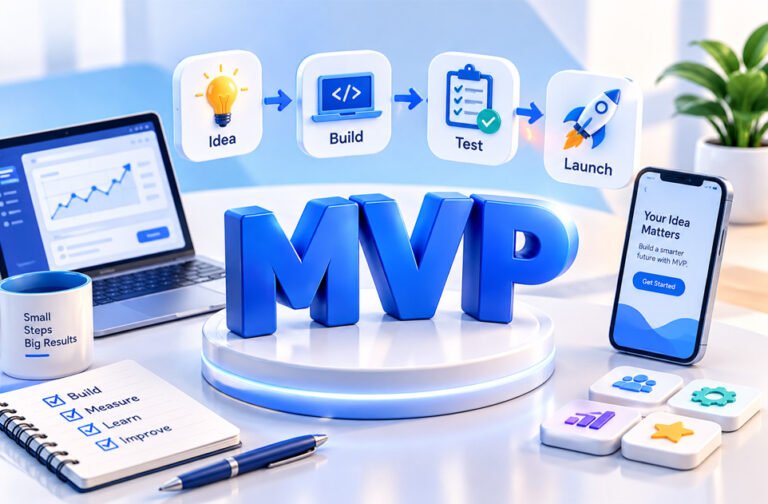
MVP development means building a simple first version of a product. It includes only the main features needed to solve a user’s problem and test the idea with real people.
Startups use an MVP to learn what customers really want before spending too much time and money on a full product. It can help test demand, collect feedback, find problems, and decide what to build next.
This guide explains MVP development, how it works, its benefits, costs, timeline, development process, and common mistakes.
What Is MVP Development?
MVP stands for Minimum Viable Product. It is a simple but working version of a new product. It has enough features to solve the main problem for early users.
MVP development is the process of planning, designing, building, testing, and launching this first version.
The word minimum means including only the features that are really needed. Viable means the product must still work properly and provide value to users.
An MVP is not a broken or poor-quality product. It should do its main job well. Extra features can be added later if users need them.
For example, imagine a startup wants to create a booking platform. The final product may have reviews, subscriptions, recommendations, loyalty points, messaging, and mobile apps.
The MVP may only let users search for a service, select a time, make a booking, and receive confirmation. This may be enough to test whether people actually want the service.
An MVP can help answer important questions:
- Does the product solve a real problem?
- Do people want to use it?
- Can users complete the main task?
- Which features are useful?
- Where are users having problems?
- Are people willing to pay?
- Is the idea worth further investment?
MVP development is closely linked to the Build → Measure → Learn approach. You build the basic product, see how people use it, learn from the results, and then improve it.
However, an MVP does not guarantee success. It simply helps a business learn about its idea earlier.
MVP vs. Prototype vs. Proof of Concept vs. Full Product
These terms are related, but they mean different things.
A Proof of Concept (PoC) tests whether an idea or technology can actually work. It is often used internally before full development begins.
A prototype shows how a product may look and work. It can include screens, buttons, and user flows. It may be clickable without being a fully working product.
An MVP is a working product that real users can use. It has enough features to provide the main value and test the business idea.
A full product is more complete. It usually has more features, users, integrations, and workflows.
| Aspect | PoC | Prototype | MVP | Full Product |
|---|---|---|---|---|
| Purpose | Test if technology works | Test design and flow | Test the product idea | Serve the wider market |
| Functionality | Small technical test | Often not fully working | Main features work | Full set of features |
| Users | Internal team | Team or test users | Real early users | Wider customer base |
| Main question | Can it work? | Is the design right? | Do users want it? | How can it grow? |
A startup may use all these stages. It may first create a PoC, then make a prototype, build an MVP, and finally develop the full product.
Why Do Startups Build an MVP?
Building a complete product can take a lot of time and money. A startup may spend months building something without knowing if customers actually want it.
An MVP helps test the idea earlier.
Validate the Core Idea
An MVP lets real people use the product.
This gives better information than simply asking people if they like the idea. Someone may say they would use a product but never actually sign up, pay, or return.
Real user behavior helps show whether the idea has value.
Get Real User Feedback
Users may find problems that the development team did not notice.
They may find the sign-up process confusing, struggle with a feature, leave during an important step, or ask for something that is missing.
This feedback can help improve the product.
Reduce Unnecessary Development
A complete product may have many planned features. Some may not actually be useful.
An MVP focuses only on important features. Other features can wait until the startup knows users need them.
Control the Initial Investment
A smaller product usually requires less development work than a full product.
However, an MVP still needs proper planning, design, development, testing, security, and deployment.
The goal is to avoid spending money on features that are not needed yet.
Reach the Market Earlier
Because an MVP has fewer features, it can often be launched sooner.
The startup can then start collecting feedback and real user data earlier.
Build a Better Product Roadmap
Before launch, teams often guess what users want.
After launching an MVP, they can use real data, feedback, support requests, and user behavior to decide what should be built next.
Support Investment Decisions
A working MVP can also help when talking with investors or business partners.
A startup may be able to show real users, retention, conversions, feedback, or early revenue.
However, an MVP does not guarantee investment. Investors may also look at the market, team, competition, business model, and growth potential.
What Should an MVP Include?
There is no fixed list of features for every MVP.
The features depend on the product, target users, problem, and business model.
The first step is to find the core user journey. This is the main process a user follows to get value from the product.
For a booking platform, it could be:
Search → Choose service → Select time → Book → Get confirmation
The MVP should make this main process easy and reliable.
Before choosing features, ask:
- Who will use the product?
- What problem do they have?
- What is the main task they need to complete?
- Which features are needed for that task?
- Which features can be added later?
Features can then be divided into three groups.
Must-have features are needed for the product to work.
Useful but nonessential features can improve the product but are not needed for the first version.
Future features can be saved for later when there is more information about what users want.
Having fewer features does not mean the product should be poor quality. The main functions should still be easy to use, reliable, and properly tested.
How to Prioritize MVP Features
Feature prioritization means deciding which features should be built first.
One popular method is MoSCoW:
- Must have: The product needs this feature.
- Should have: Important, but the product can launch without it.
- Could have: A useful extra for later.
- Won’t have for now: Not needed in the first version.
Another method is RICE. It looks at Reach, Impact, Confidence, and Effort.
The Kano model looks at how different features can affect customer satisfaction.
A startup does not need to use every method. The main goal is to choose features carefully.
Each feature should have a clear purpose. Teams should think about user value, development time, cost, technical needs, and what the MVP is trying to test.
Other good ideas can be saved for later.
This also helps prevent scope creep. Scope creep happens when more features keep being added and the MVP becomes bigger, slower, and more expensive than planned.
MVP Development Process
Building an MVP requires a clear process. The goal is to understand the problem, build the important features, launch the product, and learn from real users.
Step 1: Define the Problem
Start by understanding the problem.
Find out who has the problem, why it matters, and how people currently solve it.
A simple statement can help:
“We help [target user] do [specific task] without [main problem].”
If you cannot clearly explain the problem, you may not be ready to start development.
Step 2: Research the Market and Target Users
Research the people who may use your product.
You can use customer interviews, surveys, competitor research, and market research.
Find out what users currently do, what problems they face, and what solutions they already use.
Also study competitors. Look for gaps where your product may offer something simpler, faster, cheaper, or more suitable for a certain group.
Step 3: Define the Value Proposition
A value proposition explains why someone should use your product.
It should answer three simple questions:
Who is the product for? What problem does it solve? What useful result does it provide?
Focus on the result for the user instead of creating a long list of features.
Step 4: Set Validation Goals and Success Metrics
Decide what you want to learn from the MVP.
For example, you may want to know whether users make a booking, return to the app, use an important feature, or pay for the service.
Choose useful measurements before launching.
These may include activation, engagement, retention, task completion, and conversion.
Clear goals make it easier to decide whether the MVP is working.
Step 5: Choose and Prioritize Features
Choose the features needed for the main user journey.
Keep only the features needed to solve the main problem and test the idea.
Other ideas can be saved for later versions.
Try not to keep adding new features during development unless they are really necessary.
Step 6: Create Wireframes and UX/UI Design
Wireframes are simple layouts that show how screens and pages will work.
Start with basic wireframes to plan navigation and the main user flow.
You can then create more detailed designs or a clickable prototype.
Testing the design before development can help find confusing screens, missing steps, and other usability problems.
An MVP does not need fancy animations or complex designs. It needs to be clear and easy to use.
Step 7: Choose the Technology
Choose technology based on what the product needs.
A website, mobile app, SaaS platform, marketplace, and internal tool may all need different technologies.
Consider development speed, security, maintenance, integrations, expected users, and future plans.
You can also use existing services for payments, login, maps, messaging, and analytics instead of building everything yourself.
No-code or low-code tools may work for some simple MVPs.
Custom development may be better when the product needs special features, complex integrations, better performance, or more control over the code.
Step 8: Develop the MVP
Development can be divided into short Agile sprints.
Each sprint focuses on a small amount of work. The team can review the product regularly and find problems earlier.
Build the main feature first. Add supporting features such as login, payments, notifications, or an admin panel only when they are needed.
Analytics should also be added so the team can understand what users do after launch.
Step 9: Test the MVP
Test the product before releasing it to users.
Functional testing checks whether features work correctly.
Usability testing checks whether people can easily use the product.
Performance testing checks whether the product is fast and stable enough.
Testing may also cover browsers, devices, integrations, errors, security, and data handling.
Fix serious problems before launch. Small improvements can be saved for later.
Step 10: Launch the MVP
When the product is ready, release it to real users.
Some startups begin with a soft launch. This means giving access to a smaller group first.
Set up analytics and monitoring before launch.
Also give users a simple way to send feedback. This may be an email, survey, chat, or feedback form.
Basic customer support can help solve early problems and collect useful information.
Step 11: Measure, Learn, and Improve
After launch, compare the results with the goals you set earlier.
Analytics can show what users are doing. Interviews, surveys, and support messages can help explain why they are doing it.
Do not add every feature users request. Look for common problems and repeated requests.
The results may tell you to improve the current product, add a feature, change the design, target different users, change the business model, or take the product in another direction.
Sometimes the results may show that the idea is not worth further investment.
This can still be useful. The MVP has helped the business learn before spending more money.
How Long Does MVP Development Take?
There is no fixed MVP development timeline.
A simple MVP may take less time than a marketplace or mobile app with payments, many user types, integrations, and complex security.
One source collected for this article suggests that 60 to 90 days can be possible for many well-focused MVP projects. However, this is only an example. Some products can take less or much more time.
The timeline should include research, planning, design, development, testing, and launch.
Development may take longer when the product has:
- Many features
- Complex design
- Web and mobile apps
- Several user roles
- Third-party integrations
- Complex backend systems
- Special security needs
- More testing requirements
- Changes during development
The MVP scope should be clear before estimating the development time.
How Much Does MVP Development Cost?
There is no fixed cost for MVP development.
The price depends on the product, number of features, design, technology, integrations, security, and development team.
A simple web tool may cost much less to build than a marketplace, SaaS platform, or complex mobile application.
The main cost factors include:
- Number and complexity of features
- UI/UX design
- Web or mobile platform
- Technology stack
- Third-party integrations
- User roles
- Security and compliance
- Testing
- Development team
- Hosting and infrastructure
- Maintenance
Startups should also think about costs after launch. These can include hosting, APIs, monitoring, support, maintenance, and future updates.
When hiring an outside development team, ask for a clear breakdown of the cost.
The agreement should also explain who owns the source code and intellectual property.
The best way to control MVP development costs is usually to control the scope. Important testing, security, and usability work should not be removed just to save money.
Choosing a Technology Stack for an MVP
There is no single best technology for every MVP.
The right technology depends on what you are building.
For web products, developers may use React or Next.js for the frontend and Node.js or Django for the backend.
For mobile apps, Flutter and React Native can be used to build apps for Android and iOS with a shared codebase.
Database options may include PostgreSQL or MongoDB.
Cloud and hosting options can include AWS, Google Cloud, Firebase, or Vercel.
Startups can also use existing services for payments, login, messaging, maps, and analytics. This can save development time.
No-code and low-code tools may be enough for some simple ideas.
Custom development may be better for products that need special features, complex integrations, strong performance, or full control over the code.
Do not choose technology simply because it is popular. Choose what fits the product.
How to Measure MVP Success
The best way to measure an MVP depends on what you are trying to test.
A large number of downloads or sign-ups does not always mean success. People may sign up and never use the main feature.
Useful MVP metrics include:
Activation rate: How many new users complete an important first action.
Task completion rate: How many users successfully complete the main task.
Retention: How many users return to the product.
Engagement: How often people use important features.
Conversion rate: How many users complete a goal, such as buying something or starting a paid plan.
Customer acquisition cost: How much the business spends to get a customer.
User feedback is also important. Interviews, surveys, reviews, and support messages can explain problems that numbers alone cannot show.
Use both data and feedback when deciding what to do next.
An MVP can still be useful even when it shows that the original idea needs major changes.
Benefits of MVP Development
MVP development can provide several useful benefits.
- Test ideas earlier: Find out whether people want the product before building everything.
- Lower initial scope: Build fewer features at the start.
- Get real feedback: Learn directly from actual users.
- Learn faster: Use real behavior instead of guesses.
- Choose better features: See which functions users actually need.
- Launch earlier: A smaller product may reach the market sooner.
- Reduce unnecessary work: Avoid building features that people may not use.
- Improve future planning: Use real data to create the product roadmap.
A working MVP and real usage data may also be useful when talking to investors. However, an MVP does not guarantee funding.
Limitations and Drawbacks of MVP Development
An MVP can reduce risk, but it cannot remove all risk.
It does not guarantee that the product will succeed or achieve product-market fit.
Testing with the wrong users can also give misleading results.
Making the MVP too small can be another problem. If important features are missing, users may not understand the real value of the product.
Poor design can also affect the results. Users may leave because the product is difficult to use rather than because the idea is bad.
An MVP still requires planning, design, development, testing, security, and maintenance.
Taking too many technical shortcuts can also create problems later. If the product grows, weak code or poor architecture may need major changes.
User feedback can also be difficult to understand. Teams should look for repeated problems instead of adding every feature someone requests.
Common MVP Development Mistakes
One common mistake is skipping market research. A startup may build something without knowing whether enough people actually need it.
Another mistake is starting without a clear goal. The team should know what it wants to learn before building the MVP.
Building too many features can make development slower and more expensive. It can also make the product harder to test.
Treating an MVP as a low-quality product is also a mistake. Fewer features should not mean poor usability, weak security, or broken functions.
Skipping wireframes and design testing can create problems that could have been found before coding.
Choosing technology before understanding the product can lead to unnecessary technical work.
Scope creep is another common problem. It happens when new features keep being added during development.
Startups should also avoid launching without analytics or clear success metrics.
Finally, do not treat every piece of user feedback as a new feature request. Look for repeated needs and understand the real problem first.
When an MVP May Not Be the Right Approach
An MVP is useful for many startups, but it is not right for every product.
Sometimes a Proof of Concept should come first. This is useful when you first need to know whether the technology can work.
A prototype may be better when you mainly need to test the design or user experience.
Some products may need a more complete first version.
This can include safety-critical products, heavily regulated software, and systems where reliability is extremely important.
Some products also need several connected systems before they can provide any real value.
The right approach depends on the product, its risks, and what the business needs to test.
How to Choose an MVP Development Team
An MVP can be built by an in-house team, freelancers, or a software development company.
A team may include a product manager, UX/UI designer, frontend developer, backend or full-stack developer, and QA specialist.
Smaller projects may have people handling more than one role.
Look for a team that understands both development and product validation.
The team should be able to explain technical choices, question unnecessary features, identify problems, and keep the MVP focused.
If you hire an outside company or freelancers, ask about:
- Project scope
- Cost and payment milestones
- Communication
- Development timeline
- Testing
- Regular product demos
- Source code ownership
- Intellectual property
- Maintenance
- Support after launch
A good team should help keep unnecessary features out of the first release instead of simply agreeing to build everything.
From MVP to Full Product
If the MVP performs well, the product can continue growing.
Start by fixing problems in the main user journey.
Then use user feedback, analytics, and business goals to decide which features should be added next.
The technology may also need to grow with the product. Hosting, infrastructure, performance, security, monitoring, and support can be improved as more users arrive.
A well-built MVP may become the base of the full product. In some cases, parts of the product may need to be rebuilt as requirements become clearer.
Do not stop learning after the MVP stage. Continue testing new features and changes with real users.
Moving from MVP to a full product is usually a gradual process.
Bottom Line
MVP development helps startups test an idea before making a much larger investment.
A good MVP has fewer features, but it should still be useful, easy to use, and reliable.
The process starts by understanding the problem. It then moves through research, feature selection, design, development, testing, launch, and improvement.
The main goal is not simply to launch a product. It is to learn whether the idea is worth developing further and what should happen next.
Frequently Asked Questions
What does MVP stand for in development?
MVP stands for Minimum Viable Product. It is a simple first version of a product made to test an idea with real users.
What is the main purpose of MVP development?
The main purpose is to test a product idea before spending too much time and money on the full product.
Is an MVP the same as a prototype?
No. A prototype mainly shows how a product may look or work, while an MVP is a working product that real users can use.
How much does it cost to develop an MVP?
There is no fixed price. The cost depends on the features, design, platform, technology, and development team.
How long does it take to develop an MVP?
It depends on the product. Some focused MVPs may take around 60 to 90 days, while more complex ones can take longer.
How many features should an MVP have?
There is no fixed number. An MVP should only have the main features needed to solve the user’s problem and test the idea.
Can an MVP become the final product?
Yes. An MVP can grow into a full product by adding new features and improvements over time.
Does every startup need an MVP?
No. Some startups may need research, a prototype, or a Proof of Concept before building an MVP.
